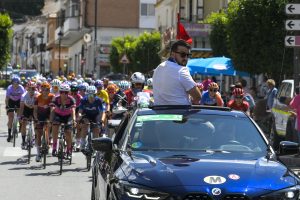
Foto Jesus Jimenez Photographerssports
With the VeloViewer WorldTour Package now adopted by over 200 Race Organisers across the globe, we wanted to provide an insider’s view on how the software is transforming cycling races – streamlining the planning process and setting new standards for athlete safety.
For this we spoke to Pau Cuevas Roura who was keen to break down his experience of VeloViewer having used the software for multiple events, including the Spanish races the Ruta del Sol and the Clàssica Terres de l’Ebre.
Introducing Pau
VV: As a Race Organiser what does your role entail?
Pau: I work in the organisation of professional cycling races, focusing on technical route planning and race safety management.
My work begins long before race day. It involves analysing every kilometre of the course, identifying critical points, coordinating with local authorities, and ensuring that teams and organisers have access to accurate and detailed information.
In races such as the Ruta del Sol and the Clàssica Terres de l’Ebre, my responsibility is to anticipate risks, optimise logistics, and help deliver an event that meets the highest standards of safety and professionalism.
Within this context of technical planning and safety management, having tools that allow for precise route analysis and proactive risk assessment has become essential. This is where VeloViewer became part of my way of working.
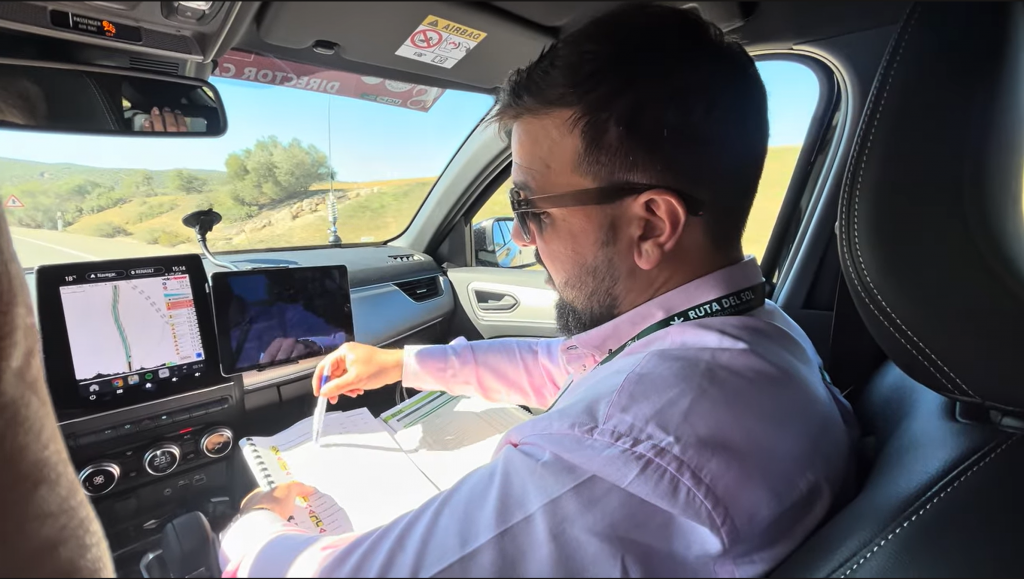
VeloViewer Partnership
VV: How did you first discover VeloViewer, and at what point did you decide to integrate it into the organisation of professional races such as Ruta del Sol?
Pau: I first became aware of VeloViewer through the teams. Many of them were already using it to prepare races, highlight key tactical points and mark potential hazards along the route. What caught my attention was how a tool designed primarily for performance analysis could also have a direct impact on safety.
In 2022, during an AIOCC meeting — even before the first official Safety Manager course was launched in 2023 — I discussed with several organisers how this kind of tool could go beyond team use and become part of the organisational workflow. If teams were using it to anticipate tactical scenarios, it made sense for organisers to use it to anticipate risk.
In 2024, we took a further step with the agreement reached alongside the AIOCC to fully integrate VeloViewer within race organisations, in line with the evolution being driven by the UCI and the work of the SafeR Commission in strengthening safety standards. Since then, it has become a structural part of my working methodology.
The Tool in Action
VV: How do you integrate VeloViewer into the race planning process, from route design to race week?
Pau: I integrate VeloViewer from the moment the route begins to take shape. Once a provisional course is defined, I carry out a detailed technical review: profiles, gradients, transitions, urban approaches, changes in road width, technical descents and potential friction points.
That digital analysis forms the foundation. The second phase is on-site supervision. With the prior review as a reference, I personally inspect the route, adjust waymarkers and verify that what we have analysed digitally corresponds exactly to the reality on the ground. That comparison is essential to minimise uncertainty.
During race week, the platform becomes a validation tool, ensuring that the final information shared with teams is clear, consistent and useful. I don’t see it as an optional add-on, but as part of an integrated prevention system.
VV: Which features of the WorldTour package do you consider most decisive for logistics and safety?
Pau: The ability to structure annotations and categorise critical points is fundamental. It’s not just about marking a location on a map, but understanding what might happen there within the context of racing conditions.
The interactive profile and segment breakdown help identify moments where intensity increases — for example, before climbs, in technical finales or in sections where the rhythm changes sharply. That allows us to prioritise interventions and reinforce signalling where needed.
The continuous development of the tool is also important. As the platform evolves, the level of detail improves, and that aligns with the growing demands of professional cycling. Safety standards cannot remain static.
VV: Can you share a specific example where VeloViewer made a real difference in preparation or decision-making?
Pau: A very representative case was the 3rd stage of the Vuelta a Andalucía-Ruta del Sol ( Jaén – Lopera), in an area that had been significantly affected by adverse weather in the preceding months.
The pre-race analysis highlighted a combination of factors in the final kilometres: a fast approach before entering an urban section, directional changes and a narrowing point that, under race tension, could generate instability within the peloton.
Based on that review, we reinforced signage, adjusted waymarkers and adapted the communication shared with teams so that sports directors had a clear understanding of the technical context of the finale.
During the stage itself, additional points were added live through the platform, coordinated with Race Radio and the sports directors’ WhatsApp group. Combining structured pre-race planning with real-time updates ensured consistent and transparent information flow throughout the day.
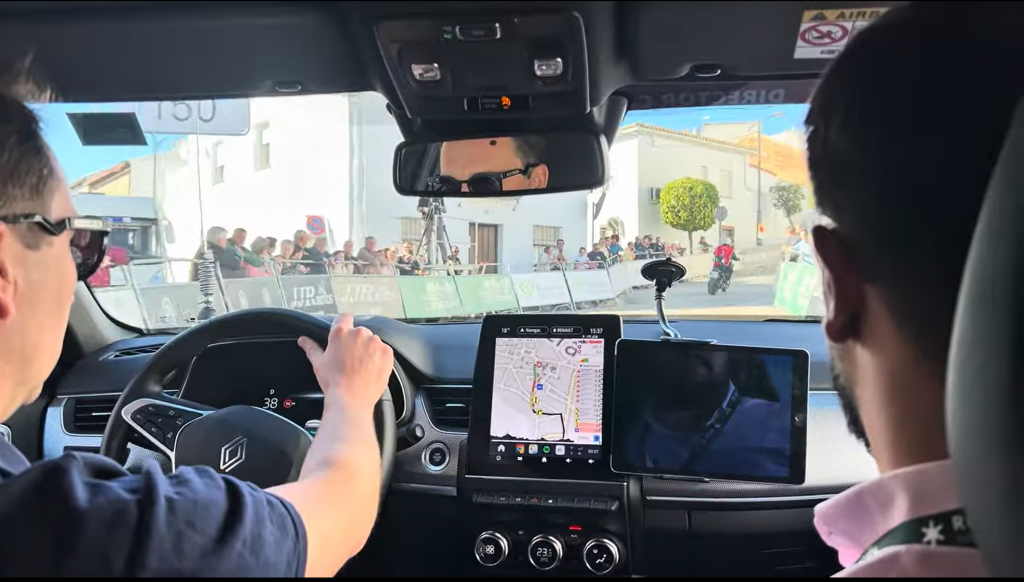
Safety and Risk Prevention
VV: How does VeloViewer help the Safety Director’s job of anticipating and highlighting risks along the route?
Pau: A Safety Manager must interpret the route not just as a course, but as a dynamic environment where speed, terrain, race tension and context all interact.
The platform allows that analysis to be approached in a structured and objective way. It helps prioritise risk areas and establish consistent criteria for signage and communication.
Experience remains essential, but today it must be supported by technical analysis and reliable data. That balance between on-the-ground knowledge and analytical tools defines modern safety management.
VV: Has it enabled you to detect or correct critical points that could have posed a problem during the race?
Pau: Yes, on several occasions. Often it is not a single obvious obstacle, but the combination of smaller factors that can create risk under racing conditions.
Detailed analysis has allowed us to reinforce signage, adjust placements or refine pre-race communication with teams. These are not always visible changes, but they contribute significantly to reducing exposure to risk.
The key difference lies in acting before an issue materialises, rather than reacting afterwards.
Impact on Teams and Sporting Strategy
VV: How does detailed route information influence sports directors and team strategy?
Pau: Structured and precise route information allows sports directors to prepare stages with greater clarity.
It is not only about knowing where a climb or sprint is located, but about understanding how the race approaches that point. A speed bump, a cobbled section or a poorly signposted transversal drainage cover can change the dynamics of a finale and create unexpected movements in the bunch.
When everyone operates from the same technical framework, uncertainty is reduced and the race develops in a safer and more controlled manner.
Professionalisation and the Future
VV: How do you envision the future of technology and data analysis in race organisation and safety?
Pau: Professional cycling is moving toward a more technical, coordinated and standardised safety model.
Experience will always be fundamental, but it must be complemented by tools that allow accurate analysis and transparent information sharing. Technology is not a trend, it is a necessary step in raising standards and consolidating a modern approach to safety management.
Ultimately, the objective is not only to reduce risk, but to strengthen the professionalism of the entire organisational ecosystem.
To make contact with Pau Cuevas Roura and learn more about his expertise in race management contact him via email or mobile +34 628 27 04 67